
For many Wisconsin hunters, deer season is about far more than filling a tag. It is time outdoors, time with family and friends, and a tradition that patients are understandably eager to resume after shoulder surgery.
Whether you have had a rotator cuff repair or shoulder replacement, returning to deer hunting requires more than simply waiting a certain number of months. You need enough motion, strength, endurance, and confidence to safely handle your equipment and manage the demands of the hunt.

Dr. Tony Trenga is a fellowship-trained hand and upper-extremity surgeon at Hand to Shoulder Specialists of Wisconsin and the Orthopaedic Hospital of Wisconsin. He helps patients return safely to the activities that matter most to them-including hunting, fishing, work, and recreation.
Some of the most common questions after shoulder surgery are:
When Can I Return to Deer Hunting With a Bow or Rifle?
The answer depends on your surgery, your recovery, the shoulder involved, and the type of hunting you plan to do.
Bow hunting generally places greater and more sustained demands on the shoulder than rifle hunting. Drawing, holding, and repeatedly shooting a bow require shoulder strength, control, and endurance. Rifle hunting may be easier to modify, but recoil, firearm weight, awkward shooting positions, carrying equipment, and game retrieval still place meaningful stress on the shoulder.
The best return plan is individualized. Your surgical team should consider your healing, motion, strength, pain level, and ability to perform hunting-specific movements safely.
What Does Hunting Require From the Shoulder?
A successful hunt can involve much more than taking one shot. Depending on your setup, shoulder demands may include:
- Carrying a firearm, bow, pack, or climbing equipment
- Drawing and holding a bow at full draw
- Supporting a rifle in a standing, kneeling, or seated position
- Managing rifle recoil
- Entering and exiting a blind or tree stand
- Pulling, lifting, dragging, or loading a harvested deer
- Navigating uneven ground while carrying equipment
Before returning, the shoulder should be prepared for the entire hunting experience—not only the moment of shooting.
Returning After Rotator Cuff Repair
A rotator cuff repair requires time for the repaired tendon to heal to the bone. Early recovery focuses on protecting the repair and restoring motion. Strengthening and sport-specific activity are introduced gradually as healing progresses.
There is no single return-to-hunting date that applies to every rotator cuff repair. Tear size, tendon quality, number of tendons repaired, associated procedures, age, work demands, and rehabilitation progress all matter.
Research on rotator cuff repair shows that return to sport can take many months. Research has shown return to sport takes a minimum of 6 months and often longer [1, 2]
Can I Bow Hunt After Rotator Cuff Repair?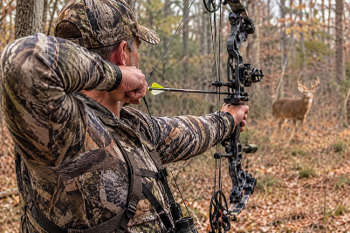
Bow hunting is usually the higher-demand activity after rotator cuff repair. The shoulder must tolerate force during the draw, maintain a stable position at full draw, and control the bow with repeated shots.
Before returning to bow hunting, patients should be able to complete simulated draw movements and progressive resistance exercises without pain, weakness, compensation, or increased soreness the next day.
A typical progression may include:
- Begin with the strengthening program prescribed during rehabilitation.
- Add controlled, hunting-specific movements when cleared.
- Practice drawing a bow at low resistance or low draw weight.
- Start with brief, close-range range sessions.
- Progress draw weight, shooting distance, and number of shots gradually.
- Delay heavy equipment handling, climbing, dragging, and lifting until those tasks can be performed safely.
Patients should not assume that one pain-free shot at the range means the shoulder is ready for a full day of hunting in cold weather or an unexpected field-retrieval situation. Depending on the timing of your surgery, patients often use a crossbow for their first season back as they ease into bow hunting.
Can I Rifle Hunt After Rotator Cuff Repair?
Rifle hunting may be feasible before bow hunting for some patients, but this depends on the firearm, recoil, shoulder position, and overall stage of recovery.
The rifle stock places pressure directly through the shoulder, and recoil can be uncomfortable or unsafe if the repaired shoulder has not regained sufficient strength and control. Carrying a firearm over uneven terrain or stabilizing it in an unsupported position can also be demanding.
Ways to reduce stress on the shoulder include:
- Using a lighter-recoiling firearm when appropriate
- Adding a quality recoil pad
- Practicing from a supported position, such as a blind, bench, tripod, or shooting rest
- Starting with brief range sessions before the season
- Asking a hunting partner to assist with gear, stands, dragging, and loading
If range practice produces pain, weakness, instability, or prolonged soreness, the shoulder is likely not ready for the full demands of the hunt.
Returning After Shoulder Replacement Surgery
Shoulder replacement surgery may involve an anatomic total shoulder arthroplasty or reverse shoulder arthroplasty. These procedures have different indications, mechanics, and rehabilitation precautions. Return to hunting should therefore be based on the individual procedure and recovery rather than a universal timeline.
A recent study specifically examined return to outdoorsman sports-including shooting and archery-after primary total shoulder arthroplasty. Overall, 77% of patients returned to outdoor activities. Return rates were 85% for shooting and 50% for archery. Among those who returned to these activities, more than half did so within 6 months after surgery. [3]
These results are encouraging, but they do not mean every patient should return at 6 months or return to the same equipment, draw weight, shooting volume, or hunting setup used before surgery.
Can I Bow Hunt After Shoulder Replacement?
Archery can be possible for selected patients after shoulder replacement, but it is often more demanding than firearm use. In the outdoorsman-sports study, archery had a lower rate of return than shooting, likely because it requires greater sustained shoulder loading and endurance. [3]
Both shoulders matter in archery. The drawing shoulder must pull the string smoothly and repeatedly, while the bow-holding shoulder must remain stable at full draw. A prior shoulder replacement can affect either role.
Important questions before returning include:
- Can you draw the bow without pain or altered mechanics?
- Can you hold the bow steady without fatigue?
- Do you have the range of motion needed for your usual shooting positions?
- Can you safely manage a blind, tree stand, pack, and uneven terrain?
- Would lower draw weight or another legal hunting adaptation allow a safer return?
A gradual progression is essential. Start with low resistance and short practice sessions. Increase demand only when the shoulder tolerates each stage without pain or delayed soreness.
Can I Rifle Hunt After Shoulder Replacement?
Rifle hunting is often easier to modify after shoulder replacement than bow hunting. A shooting rest, seated position, ground blind, lighter firearm, or recoil pad can reduce the demand on the shoulder.
Practice at the range should come before opening day. Start with a controlled and supported shooting position, use a low-recoil setup when possible, and pay attention to how the shoulder feels later that day and the following morning.
How Do I Know My Shoulder Is Ready?
Time from surgery is important, but it is only one part of the decision. Before returning to deer hunting, most patients should have:
- Minimal or no pain during daily activity and range practice
- Adequate motion for safe bow or firearm positioning
- Functional strength and endurance for the planned activity
- No instability, catching, or loss of control during shooting-specific movements
- The ability to safely carry essential equipment
- A gradual practice progression without significant next-day pain
- Clearance based on their individual surgical procedure and recovery
Return-to-sport planning should consider shoulder capacity, tolerance to gradually increased load, patient-reported symptoms, and functional performance—not time alone. [4]
Practical Ways to Make the First Season Back Safer
A successful return does not always mean returning to the exact same hunting style immediately. Temporary modifications can protect the shoulder while keeping patients involved in the season.
Consider:
- Hunting from a ground blind instead of a tree stand
- Using a shooting rest, tripod, monopod, or sandbag support
- Selecting a lighter firearm or lower-recoil option when appropriate
- Using a lower bow draw weight or other legal equipment modification
- Use a crossbow
- Planning shorter hunting sessions initially
- Having a partner assist with stands, gear, field dressing, dragging, and loading
- Using a cart or retrieval device rather than dragging a deer
- Avoiding heavy lifting and awkward, unexpected pulling tasks
Final Thoughts
Most patients are motivated to return to the outdoor activities they enjoy after shoulder surgery. For many, deer hunting is an achievable goal—but it should be approached as a gradual return, not a single date on the calendar.
Rifle hunting may be easier to adapt early in recovery, while bow hunting generally requires more shoulder strength, endurance, and control. A safe return depends on preparing the shoulder for every part of the hunt: carrying equipment, reaching, positioning, shooting, and managing game after the shot.
If you are recovering from rotator cuff repair or shoulder replacement and hope to hunt this season, discuss your specific goals early during your follow-up visits. A thoughtful progression can help protect your surgical outcome while getting you back to the woods safely.
If you are considering shoulder surgery and wanting to be back to bow or rifle hunting the following season, December through February are ideal times for surgery to avoid missing out on this season and to get ready for next season.
For assistance with any problem of the hand, wrist, elbow, or shoulder, call 414-453-7418 or visit HSSWI.com to schedule an appointment.
About Dr. Trenga:
Anthony P. Trenga, MD is a fellowship-trained hand surgeon specializing in all aspects of the hand, shoulder, and elbow. Originally from the east coast, Dr. Trenga, his wife, and two children have made Wisconsin home for nearly a decade. Dr. Trenga sees patients throughout the greater Milwaukee area.
About Hand to Shoulder Specialists of Wisconsin:
HSSWI, formerly Hand Surgery Ltd, is dedicated to treating all aspects of the upper extremity in Southeastern Wisconsin. All surgeons at HSSWI are fellowship-trained in hand and upper extremity surgery to provide comprehensive subspecialist care unique to the region.
Sources:
- Return to sport after arthroscopic rotator cuff repair: epidemiology and prognostic factors in a Swiss multicentre cohort. British Journal of Sports Medicine, 2026
- Return to sport at 6 months after shoulder surgery. Orthopaedic Journal of Sports Medicine, 2019
- Return to outdoorsman sports after primary total shoulder arthroplasty. Orthopaedic Journal of Sports Medicine, 2025
- Rotator cuff tendinopathy diagnosis, nonsurgical medical care, and rehabilitation: a clinical practice guideline. The Journal of Orthopaedic and Sports Physical Therapy, 2025